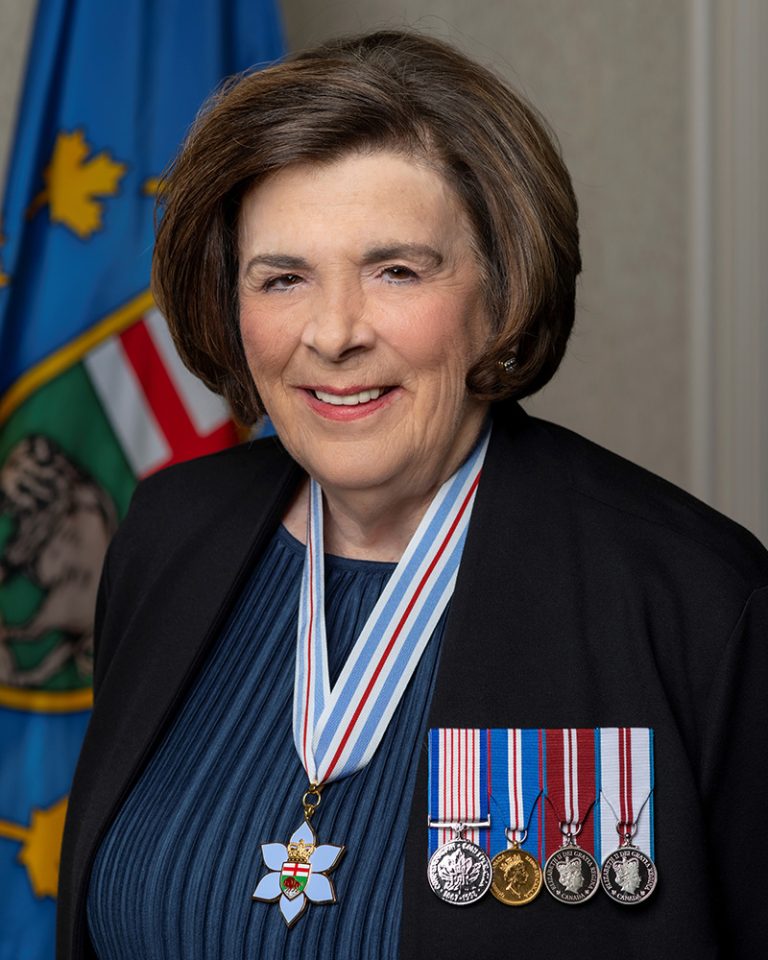
Lieutenant Governor Anita Ruth Neville is receiving the Sol Kanee Distinguished Community Service Medal at the Jewish Federation of Winnipeg’s Kavod Awards. Neville was appointed in 2022 by former Prime Minister Justin Trudeau to be lieutenant Governor and is richly deserving of this distinction.
Neville, a former Member of Parliament held the Winnipeg South Centre seat for the Liberals from 2000-2011 and made history by becoming the first Jewish Lieutenant Governor in the Province.
On Oct 7, 2024, which marked one year after the Hamas attacks, Neville spoke of “the unspeakable tragedy that was unleashed on this date last year”, and in “support the families mourning innocent lives lost.” She noted that we need “to take a stand against the rising tide of antisemitism – which predated last Oct 7 by many years.”
She then expressed sentiments then that have only become more pronounced with the passage of time. ‘Around the world and right here in Canada – we have witnessed increased threats and acts of violence against Jewish community centres, schools, synagogues and Jewish-owned businesses.”
She spoke of the need to deepen our identity as Jews. “… [W]e must remember who we are, and reaffirm our commitment to community, and to our faith.”
‘With passions and global tensions high, it is imperative that we stand united, citizens of the world, regardless of religion or race, against all forms of racism and scapegoating and collective blame. On this day we stand against antisemitism, just as we stand against all other forms of racism and intolerance,” she stated.
Neville, who was a Board member of Shaarey Zedek synagogue, spoke at the Shaarey Zedek Synagogue’s sisterhood luncheon in 2025 noting it was an event ‘that has been part of an effort toward greater understanding and appreciation of differences.” She added “But we have seen in recent years that the work of these efforts are not done. Amid rising antisemitism and poisonous online discourse about race, religion, gender and culture, we need to celebrate interfaith and intercultural dialogue more than ever.”
Neville has spoken about her maternal grandparents who immigrated to Canada from Russia in 1913.Her maternal grandmother was a major influence in her life.
“Life was hard for them,” she had said in an interview with the CJN, noting that they, along with her parents, they worked to give her “better opportunities,” she said.
Neville has recalled in this interview the antisemitism faced by her ancestors in Canada.
“There were places my grandparents and parents couldn’t live, jobs they couldn’t apply for, because they were Jews,” she told the Canadian Jewish News.
While they faced overt antisemitism, she faced antisemitism that was more muted, consisting of “snide comments and jokes,” or people making antisemitic remarks. When they did this they did not know Neville was Jewish since she had married a non-Jew.
Neville, then age 80, was at her cottage with her grandchildren in when Prime Minister Justin Trudeau called to offer her the position as Lieutenant Governor. She took time to think about stepping into this very public role.
At first, some members of Neville’s family were worried the new
She made her decision thinking about her roots. She was born in the traditional Jewish immigrant neighbourhood in the North End and grew up after the Second World War, when barriers to advancement still existed for Jews.
She told the Vancouver Independent that what clinched it was when a grandson scolded her and said, “How could you not take the job? How many people get this opportunity?” Neville felt that she didn’t “want to lose face with Aaron.”
Considering saying no was “beyond his comprehension,” she told the Vancouver Independent.
Neville co-chaired the Liberal Parliamentarians for Israel caucus when she was an MP. in the House of Commons, she raised the plight of the 800,000 Jewish refugees expelled from Arab lands, pointing out that people needed to pay attention to this historic injustice.
Neville’s swearing -in ceremony included the blasts of a shofar blown by Rabbi Anibal Mass and she was sworn into office using a Hebrew Bible.
While she was a Member of Parliament, Neville supported the legalization of same-sex marriage, and advanced initiatives benefiting Indigenous Peoples, most notably on the issue of missing and murdered Indigenous women and girls. In 2003, she played an important role in the establishment of Holocaust Memorial Day by Parliament. Neville took an interest in talking to her constituents, learning about their lives, their families, and their struggles. Most importantly, she looked for opportunities to help her constituents find solutions to their problems,
Neville served as Parliamentary Secretary to the Minister of Canadian Heritage and Minister responsible for Status of Women, as well as on numerous committees, parliamentary associations, and parliamentary groups.
Neville holds a Bachelor of Arts (Honours) in political science and history from the University of Manitoba.
Throughout her life Neville has been demonstrated her commitment to education—as evidenced by her lengthy service as Chair of the Winnipeg School Division Board of Trustees. Her numerous board and volunteer activities included involvement with the Law Society of Manitoba, Jewish Child and Family Service, Rossbrook House, the City of Winnipeg’s Community and Race Relations Committee, the Manitoba Public Utilities Board, Equal Voice, the Institute for International Women’s Rights – Manitoba and the Arab Jewish Dialogue .She previously served on the Steering Committee of Operation Ezra and the board of the Jewish Heritage Centre of Western Canada.
Neville is the mother of three grown children and grandmother to six grandchildren.