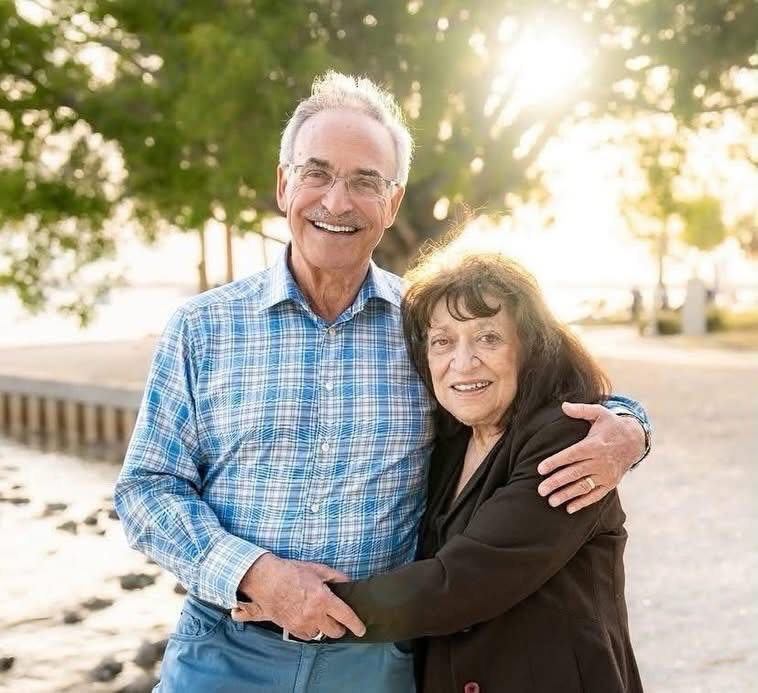
Tova Vickar was petite in stature and yet she was a giant. Let me explain.
On a “macro” level, her life was representative of a generation of heroic Jews who miraculously managed to survive the Holocaust, found themselves in displaced person camps after the war and made their way to the fledgling State of Israel, a country that opened its arms to absorb them. There in Israel they remade their lives anew.
Tova’s life exhibits all the dramatic historical events of Jewish history of her generation. Born in the aftermath of the Holocaust, she made her way to Israel by ship as a young child from Poland with her family. She was raised on a kibbutz-a unique experiment that defined Israel’s pioneering ethos— and served in the Israel Defense Forces in 1967 in the holy city of Jerusalem, a battle which changed the course of Jewish history.
Tova’s maternal grandfather was a Rabbi hanged by the Nazis. Her mother Yente hid during World War ll and Tova did not know her mother’s maiden name because her mother changed it during the war while her mother was in hiding. Tova’s father, Nachum Soiferman an officer in the Russian Army, was shot in the head at the end of the war but survived.
The name Soiferman in Hebrew means scribe” or “author” and was later anglicized to Superman. Nachum was cared for by a caring nurse—Tova’s mother, and the two were married a week later. Tova did not know for certain where or when she was born, and as she wrote in her Story in the Jewish Foundation’s Endowment Book of Life (EBOL) she knew she was born “after World War II, and I know it was somewhere between Poland and Russia, but there is no birth certificate to confirm the details.”
After the war, Tova’s parents were in a displaced persons camp in Poland waiting to immigrate to Israel. As Tova wrote in her EBOL story, “The Jewish Agency (the Sochnut) took us and so many others by train from Poland to Germany, and then to Italy where we waited for a ship to go to Israel. Through all of the angst, uncertainty, and travel, my parents did their best to keep the experience light, and even fun. As a young child I had no sense of the scale of what was happening and when I think back on it all, it is not a bad memory.”
Tova’s parents had four children in five years—Jacob, Shoshana, Tzvi, and Tova.
The family landed in the port of Haifa in 1954, where Tova was taken to an absorption centre designed just for children.
As she wrote in her EBOL story, “My father’s health had been compromised and my mother had developed a condition where she couldn’t walk well, so raising children would have been too difficult. I was born as Ogenia, but in Israel I became Tova. At the centre, which was run by the Sochnut, I remember making friends and studying Hebrew. I also remember the process by which kids were sent from the centre off to different kibbutzim and settlements. We would line up and an administrator would handpick a few children at a time to be sent to new homes. I remember being passed over a few times until the age of 12 when I was finally sent, along with a few friends from the absorption centre, to Kibbutz Ramat Ha’Shofet, near Megiddo, just west of Haifa.”
Tova believed in the notion of “Jewish people helping Jewish people” which is evidenced in the philanthropy and commitment that she and her husband Larry made on an ongoing basis to so many causes related to the wellbeing of the State of Israel, in addition to local Jewish causes. As Larry has told me over the years “Tova always wanted to give back to the country that raised her.” I have no doubt that growing up on a kibbutz , a collective society, is part of the reason that Tova embodied the notion of “ Kol Yisrael arevim zeh bazeh”, which mean “All of Israel are responsible for one another.”
In her EBOL story, Tova wrote that living in a kibbutz “was a beautiful way to grow up and learn about community.” Tova loved going to school on the kibbutz and it is no accident that the Vickar family funded a $1 million dollar project through Jewish National Fund of Canada, entitled the Tova Vickar Education and Special Needs Centre at the regional high school near Ramat Hashofet, where Tova attended classes in her youth. As Larry explained to me, the project retrofitted an auditorium and two classrooms in the school attended by some 800 children, and “we supported the school for five years.”
As a young kibbutznik, Tova was only able to see her parents twice a year, although she did have an adoptive kibbutz family who was very kind to her.
At the age of 17, Tova left the kibbutz to join the army for a year and a half. In the 1967 war, Larry recalls Tova speaking of seeing the Western Wall for the very first time.
Tova ‘s experiences growing up in Israel led to her feeling fearless and celebrating her independence. As she wrote, “It was that independence that led me to buy a one-way ticket to Winnipeg after my military service in 1969. My mother had found out that her sister Rose Levine was living in Winnipeg, so it seemed like a good place to visit.
Although arriving in Winnipeg, she missed Israel and wanted to go back but needed to make money to buy a ticket. With her broken English Tova managed to get a job at Hercules Manufacturing sewing pockets on blue jeans, where she met and made friends with members of the Filipino community. She later worked at the Sharon Home as a nursing assistant, where she spoke Yiddish to residents. She got used to life in Canada and started to study nursing and later interior design at Red River Community College.
But it was bowling that changed Tova’s life. On one cold night in the late 1960s, she went to bowl at Roxy Lanes as part of a Winnipeg Organization of Jewish Youth program. A young man named Larry Vickar offered her a ride home.
Larry tells the story that “I thought she accepted the ride because of my charm, good looks and intellect but Tova said a warm car was better than taking two buses in the cold.” Tova was attracted to the fact Larry was raised in Melfort, Saskatchewan and he and his family had a farming background, like the agricultural life of the kibbutz.
Larry and Tova were married in 1971. Their son Sam is married to Odessa and Stephen is married to Marie, both of whom have become Jews by choice. Tova and Larry have 5 grandsons: Mason and Vaughn, Theo, Owen, and Austin.
Larry always said that he was “the head of the family” but that Tova was “the neck” and she could move the head anyway she wanted to.” As Larry said at her funeral “Tova was boss #1 and I was “boss #2 and there was full agreement that boss #2 did not count.”
Tova’s life was so impactful because she was a caring compassionate soul who tried genuinely to help people from all walks of life, and whose philanthropic legacy of giving back has touched so many lives in Canada, Israel and the Philippines. Tova treated everyone with respect and as her son Sam said at her funeral when she worked at the car dealership, “She treated everyone exactly the same” no matter who they were or what their position was. Tova loved people and built relationships, and as Sam said, “she had the ability to make everyone she spoke to feel important.” Tova “loved people.” As Larry said at her funeral the name Tova means “good” and “she was good to the very core.” He stressed that Tova “knew no religious, ethnic, geographic or socio-economic barrier between people” which is why there were so many people of diverse backgrounds at her large funeral, including members of the Filipino community, the First Nations community, and the Christian community.
I remember having a meal with Larry and Tova at the L’arche Tova Café which does “good” in that it provides meaningful employment opportunities for people with developmental or intellectual disabilities who often face societal challenges like social isolation and discrimination. For dessert, the cafe served apple strudel, Tova’s own recipe which she would always make for Rosh Hashana. The Vickars have supported L’arche which provides homes for the intellectually disabled. Tova’s brother was autistic, and I have no doubt that made her very attuned to the situation of people with special needs. At that lunch, I also learned that Tova enjoyed painting.
I was at the Shaarey Zedek synagogue when the Tova Vickar and Family Child Care Centre was opened as a result of Larry and Tova giving a $1 million dollar donation. It is a lasting legacy in the Jewish community that benefits the next generation, nd brings life to the synagogue. As a child who was cared for by a kibbutz community, no doubt Tova understood the need to provide for the young. Although at the ribbon cutting of the daycare, Tova’s memory had lapses, I remember fondly speaking to her about the early days when she dated Larry, which brought me many smiles. She told me how he was lucky to have married her! I marveled at how sharp her long-term memory was as she talked about their courtship. Sam spoke of the “true love” his parents had for each other at Tova’s funeral. He jested that Tova’s favourite saying was “Where’s Larry?”
Tova always had a “positive” attitude, Larry recalls, as she struggled with cancer for over 20 years, which nine years ago became stage 4, and also in the last few years as she struggled with memory loss. Tova was remarkably resilient and lived life to the fullest.
Larry would always jest that Tova’s “boyfriend” was Chinese/Filipino singer Paul Ong. Paul and Tova developed a cherished friendship and Tova and he would sing and dance together. Tova loved music and her favourites were Elvis Presley and Paul. As Sam said at her funeral, “She danced until the very end—in her hospital bed she was moving as much as she could.”
Tova worked in the car business and made sure to talk to everyone and enjoyed getting to know them.
Tova wrote “I am a proud person who values independence and enjoys simplicity. I try to be authentic; I try to be strong; and I value family and community.” And Tova was entirely authentic.
Tova’s grandchildren Mason and Vaughn spoke about her at the funeral. A lighthearted moment was when Vaughn said he would “miss her secretly giving me money.”
In concluding her EBOL story, Tova wrote “I am expressing my passion for Jewish unity. I benefitted from the immense power of unity through my journey from Europe to Israel and then to Canada. My greatest hope is that we stay together, as we have always done.” It is a message we should all remember.
Tova loved all living things—and liked to feed the squirrels and would never kill an insect in the house but would let it live. Larry recalled with humour at her funeral how he did not kill beetles he saw in his house after she had passed in line with what Tova had taught him.
In his remarks at the funeral, Larry spoke of projects in addition to those I have already mentioned. They show the length and breadth of Tova’s legacy, a legacy of “giving back” that is truly remarkable and serves as an inspiration to us all.
One project was the Vickar Outlook over a man-made reservoir near the Hula Valley in Northern Israel, which was a JNF project. Another project supported by Larry and Tova was for the construction of the very first ANCOP Winnipeg Village in the Philippines, a lasting legacy of hope and compassion for many poor families who lived in huts with mud floors until homes for them were constructed. ANCOP stands for “Answering the Cry of the Poor” and is the social arm of Couples for Christ. The Vickars also contributed to a second ANCOP village in the Philippines which bears Tova’s name.
Tova’s name also appears on a multipurpose hall in The Vickar Transcona Rotary Portview Village and there is also a Tova room in the Rady JCC Daycare on Grosvenor.
Larry told me that Tova “always looked at the glass half full, not half empty.” It captures the essence of her life.
May her memory be a blessing.