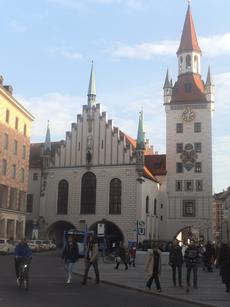
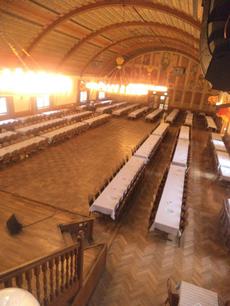
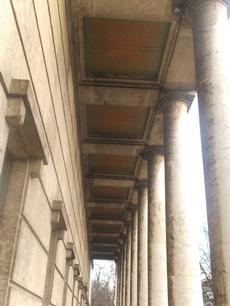
Although Munich, the Capital of Bavaria is where Hitler first founded the Nazi party, and the city is replete with Nazi era buildings and history, it was only in 2015, some seventy years after the Holocaust that Munich finally opened a Documentation Center to educate about the crimes of the Nazis. And the obvious question is why it took so long?
Munich loomed large in Adolf Hitler's rise to power. After World War I its boisterous beer halls offered Hitler, the returned soldier and failed artist, a receptive audience for his right-wing nationalist opposition to the Weimer Republic . German Jewish novelist Lion Feuchtwanger asked in his book Success, asked why it was that “everything that was rotten and bad in the Reich fled, as if by magic, to Munich”
Munich's Documentation Centre for the History of National Socialism opened after I visited Munich in 2013, such that I have not seen it, but the reason this musuem took so long to open is worth examining.
Prior to visiting Munich, I had visited Nuremberg, the city of the Nazi party Rallying grounds, which is also in Bavaria, and had gone to the Documentation Centre there. . When I later visited Munich, a far larger city, I had noticed that there was no German museum or centre specifically devoted to education about Nazism. I remember meeting an Israeli whose grandfather had been murdered in Auschwitz who said that he had visited Munich for a few days but that there really weren't any Nazi related sites for him to see in Munich. I explained to him that he was wrong and that virtually every second public building in Munich had Nazi related history but that there were very few if any signs explaining this.
After the war, Munich naturally tried to play down its 'shameful' role as the birthplace of Nazism.Many of its Nazi era buildings weren't torn down but were "normalized" and given regular uses, as Gavriel Rosenfeld has written in his book Munich and Memory; Architecture and Monuments, and the Legacy of the Third Reich.
Munich was easily able to point out that in the neighboring town of Dachau, where the Dachau concentration Camp Memorial Site was opened in the 1960's, people could remember the horrors of Nazism. Dachau, which I visited is about a half hours subway ride from the centre of Munich. In the town of Dachau a woman complained to me that Dachau gets such a "bad rap" as tourists flock to Munich to enjoy the many attractions, but the only reason they stop in Dachau is to see the concentration camp.
After the war, there was an attempt to "rehabilitate Munich image' which would no doubt encourage business and tourism, and the city was promoted as cosmopolitan. Bavarian state authorities were quite satisfied to farm out the task of publicly documenting Nasizm to the provinces, such as Dachau and Nuremberg. Many citizens of Munich also subscribed to the view that after 1933, when Hitler rose to power, Berlin became the centre where high level Nazi policy was formulated. ccordingly they felt there was no need for a museum about Nazism, as Rosenfeld relates in the book :Beyond Berlin: Twelve German Cities Confront the Nazi Past.https://books.google.ca/books?id=-Gvqb_2ekLoC&pg=PA21&lpg=PA21&dq=Beyond+Berlin:+Twelve+German+Cities+Confront+the+Nazi+Past&source=bl&ots=aGQrbUJZkB&sig=Lu6kIOAn_uW3e00o4ujraGHTt0A&hl=en&sa=X&ved=0ahUKEwjokc-ovNfQAhWJx4MKHdWhDnY4ChDoAQgfMAE#v=onepage&q=Beyond%20Berlin%3A%20Twelve%20German%20Cities%20Confront%20the%20Nazi%20Past&f=false
The proposal to create a documentation centre in Munich arose in the late 1980's , "as part of a reaction against increasing efforts to expunge from the local landscape prominent buildings that were built by or associated with the Nazi regime," according to Rosenfeld and Jascot. According to the authors, for example, in the 1980's there were "vocal calls" to tear down the Museum of Art built by the Nazis, which I visited and which today exhibits modern art, which was deemed "degenerate" by the Nazis]
Proponents of the Munich's Documentation Center [ which was eventually built on the site of the former ‘Brown House’ which used to serve as the headquarters of the National Socialist German Workers’ Party (NSDAP)], insisted that it was important to educate about Munich's central role in the rise of the Nazi party. One architectural historian went so far as to declare that Munich was "the capital of repression" in that "that neither its citizens nor tourists can learn anything in the city's public spaces about Munich's role in the Nazi era."
However, there was lots of opposition to building the Documentation Centre with many arguing that there was no need for for a museum to document Nazism in the city given other sites in Dachau, Nuremberg, as well as the Topography of Terror Exhibit in Berlin. Commentators have noted that what was really at play was the the phenomenon of downplaying the notion that citizens of Munich were "perpetrators. By not having a documentation center, Munich's perpetrator role could be expunged.
Long before the Documentation Centre on the crimes of the Nazis was built, Munich built a number of sites to memorialize the White Rose Resistance movement against the Nazis led by a non-violent group of students and a professor at the University of Munich. The overall effect of this enabled Munich conveniently to perpetuate the image of itself as the city of victims, without any perpetrators.(see: http://www.e-ir.info/2016/09/14/the-importance-of-remembering-nazi-perpetrators).