The Sea-Monday, May 18 | 7:00 p.m. | Berney Theatre | Asper Jewish Community Campus
Feature | Israel | 2025 | Director: Shai Carmeli-Pollak | Arabic and Hebrew with English Subtitles | 93 minutes
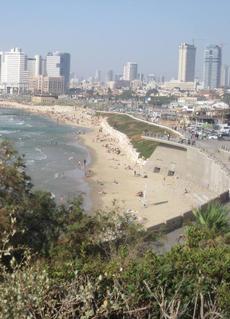
The Israeli film, “The Sea,” which was made in 2023, before the Oct 7 Hamas attacks, is about a 12 year old Palestinian boy Khaled from Ramallah who is denied a permit to visit Tel Aviv with his classmates (who have permits) to go to the Mediterranean Sea. Longing to see the Mediterranean, the heartbroken boy who speaks only Arabic courts danger by sneaking into Israel with Palestinian construction workers who are going to work in B’nai Brak. The film follows the boys journey, and also follows his father who leaves his construction site where he is working , in search of finding his son.
This Arabic-language film won five Ophir Awards — Israel’s version of the Oscars — including for best picture, which means “The Sea” was also Israel’s submission into the Academy Awards for best international feature film.
The film resonated with me on a human level as in 2008 I met a nineteen year old Palestinian woman from the West Bank who had received a permit to go to Tel Aviv for a business conference to promote Palestinian women in the West Bank opening businesses. She told me that the best part of the conference was the fact that she got to see the sea for the first time. The film tells the story from the perspective of a child, who is free from political baggage that would come with an adult’s point of view. The film really does not explain why Khaled did not receive a permit along with his classmates, and we are left to wonder if it was a simple bureaucratic mistake.
The film the Sea is directed by Israeli director Carmeli-Pollak and produced by Palestinian Baher Agbaria. The film created controversy in Israel as Israeli Culture and Sports Minister Miki Zohar, a Likud Party member, called for the defunding of the Israeli Academy of Film and Television, which runs the Ophir Awards. Zohar complained that the film cast the Israeli military in a negative light. While Israeli soldiers are not portrayed sympathetically, the film does show the humanity of some Israelis, especially a store keeper who tries to help the boy’s father in his search of his son. Because the film is told from the boy’s perspective, it has an endearing human touch, notwithstanding the film certainly has political overtones.
In my view, on the whole the fact that this film won the Best Picture in Israel is a testament to the strength of free expression in Israeli society, even after the Oct 7 attacks.
There is a Palestinian adult in the film who tells Khaled that once he is 14 he will not have any chance of getting a permit, no doubt because Israel would have potential security concerns for letting in older male teens and adults —which certainly after Oct 7,2023 certainly would be heightened.
Although the film doesn’t involve any historical perspective I think it is worth examining this aspect of things . The 1947 UN Partition plan which gave the coast from Tel Aviv to Haifa to a Jewish state was based largely on the areas where Jews had purchased land in a contiguous fashion from absentee Arab landowners as well as Palestinian Arab landowners. The coast along the sea was very fertile land. There were Palestinian Arabs including those in leadership positions in Palestinian Arab society in the 1920’s and 30’s who did not refrain from these land sales because they wished to make a profit and their nationalism did not outrank their desire for profits. Although in public Palestinian Arab leaders urged Arabs not to sell land to Jews, some of these leaders did in fact sell land.(See Oren Kessler’s book, Palestine 1936, or Tom Segev’s book, One Palestine Complete).
Had the Palestinian leadership under the Mufti of Jerusalem Haj Amin Al Husseini accepted the 1947 UN partition plan, there would have been no war and Palestinian Arabs would have had access to the sea north of Haifa in the Acre area and also in the south in the Ashkelon area as that was slated to be part of an Arab state. Jaffa near Tel-Aviv was also slated to be an Arab enclave under the plan. Once the Palestinians initiated a war, Israel won battles which left it in control of coastal land in Jaffa, around Acre as well as Ashkelon on the south.
It’s also worth noting that since the Oct 7 attacks, Israel understandably revoked the permits of many West Bank labourers from entering the country, such that men like Khaled’s father employed in Israel can no longer work there due to security considerations to ensure that no further Oct 7 like attacks occur. There are now a small faction of West Bank Palestinians who are considered essential labourers such that they receive permits. By mid 2025, some 20, 000 Indian labourers had received permits to work in Israel, and in Feb 2026, India and Israel signed agreements which include provisions for 50,000 additional Indian labourers to receive visas for work in Israel. This was a foreseeable consequence of the Hamas attacks.
I noted the film the Sea was produced by “Majdal “ productions—Majdal was the Arab town that was on the present day Ashkelon prior to the 1948 war. The nascent state of Israel battled with Egypt for Ashkelon (Magdal) But as the book ,”Collusion Across the Jordan” details, King Abdullah of Jordan who did not want Egypt to have hegemony in the area chose not to help Egypt in the battle over Ashkelon ( Magdal) even though he could have, and this was a critical factor which enabled Israel to emerge victorious in the Ashkelon area.
Even before Oct 7, it was not common to see a joint Israeli Palestinian production.